


One of the oldest debates in investing is whether wealth is created by timing the market — getting in and out at the “right” time — or by simply staying invested long enough to let compounding do its job. History offers us a clear answer.
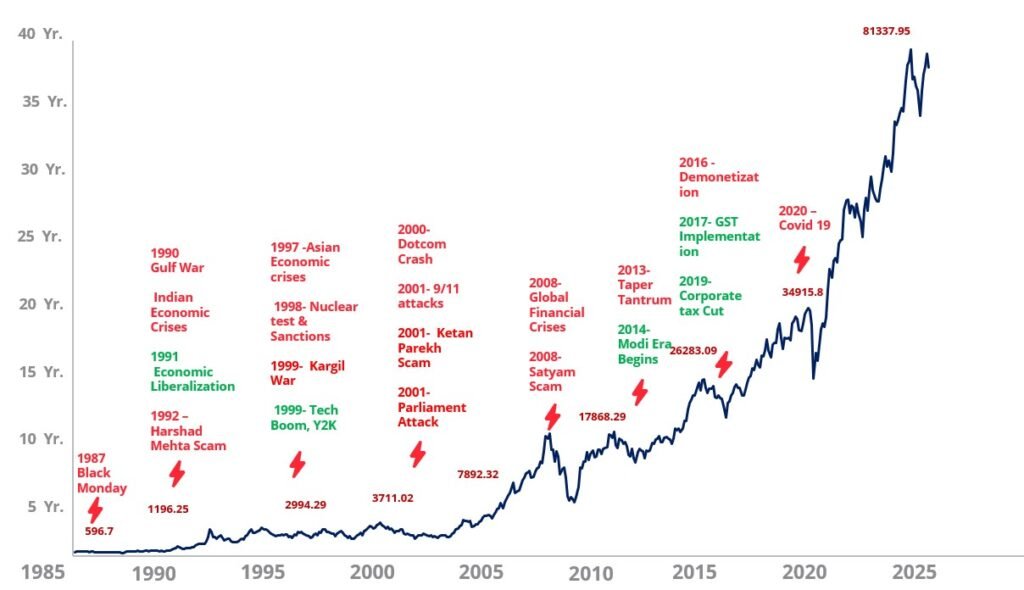
Over the past four decades, the Indian stock market has weathered many storms yet continued its upward journey. The late 1980s saw Black Monday in 1987, which shook global markets, followed by the 1990 Gulf War and India’s economic crisis, leading to the landmark 1991 liberalization reforms that changed the country’s growth path forever. Just when confidence was returning, the 1992 Harshad Mehta scam sent markets crashing. Later in the decade, the 1997 Asian financial crisis and the 1998 nuclear sanctions again rattled investors. The early 2000s brought the dotcom bust, the 9/11 attacks, and the Ketan Parekh scam, testing resilience yet again. Perhaps the biggest blow came during the 2008 global financial crisis, worsened at home by the Satyam scam, causing one of the sharpest market declines. Even as recovery began, the 2013 taper tantrum saw foreign money exiting India. In the following years, domestic reforms dominated—2016 demonetization, 2017 GST rollout, and 2019 corporate tax cuts—which disrupted in the short term but strengthened the long-term foundation. Finally, 2020 brought Covid-19, triggering the fastest and steepest crash in history, but also the most remarkable recovery, proving once again that markets may bend under pressure but rarely break.
The same picture above can be viewed in a different way. Here are here are the 5 year block returns from 1985 to 2025
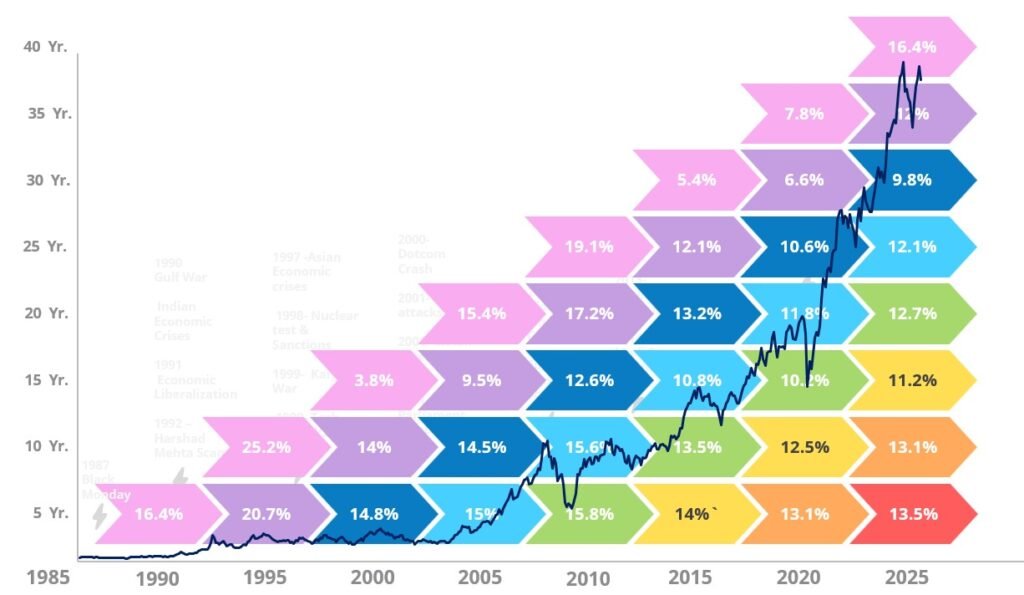
As you can see none of the 5-year block has negative returns and long-term investing can compound your wealth by about 12-15% annually.
The lesson? Every crisis felt like the end of the world in the moment, but none stopped the long-term wealth creation journey.
Yet many investors think: “If I had sold before the crash and bought back at the bottom, I would’ve made a fortune!”
Yes, in theory. But in practice, timing the market consistently is almost impossible. You need to get two decisions right every time — when to exit and when to re-enter. Miss just a few of the best days, and your returns collapse.
As Warren Buffet has rightly said “The stock market is a device to transfer money from the impatient to the patient.”
To summarize, if you stayed invested for 10, 15, or 20 years, volatility smoothed out and your wealth compounded handsomely. For example. ₹1000 monthly investment, in late 1980s with annual increase of just 5%, would make total investable amount of about 15 lakhs whose current market value would have been whopping 2.9 crores Not because of perfect timing, but because of time in the market.
Key Takeaways for Investors
- Don’t fear short-term crises. Every dip in history eventually recovered.
- Avoid chasing market tops and bottoms. It’s a gambler’s game.
- Stay disciplined with SIPs. They turn volatility into your friend.
- Think in decades, not days. True wealth creation is a marathon, not a sprint.
So instead of asking “Is this the right time to invest?”, ask yourself “How long am I willing to stay invested?”
Because in investing, it’s not about earning short term money, it’s about long-term wealth creation.